(日本語の要約は最後にあります)
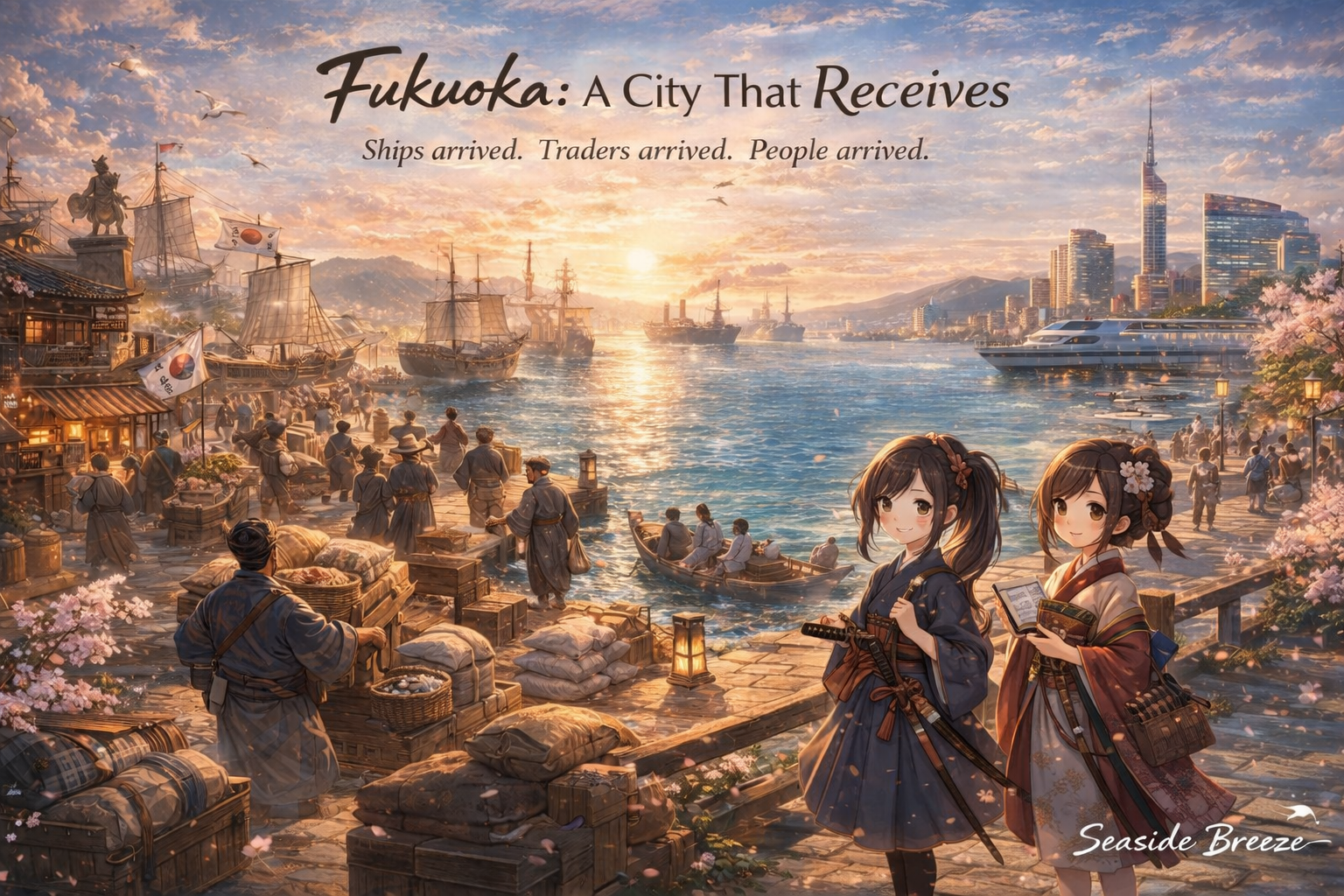
Fukuoka has rarely been a place that stands still.
Its position on the western edge of Japan made it close to many things.
Close to the Korean Peninsula.
Close to the rest of Kyushu.
Close enough for people and ideas to keep moving.
When the sea was a road, movement was natural.
Ships arrived.
Traders arrived.
Craftsmen arrived.
Some stayed.
Over time, this constant arrival shaped the city.
It is hard to remain closed when people keep coming in.
Hakata grew as a town of merchants, and merchants depend on exchange.
Exchange of goods.
Exchange of language.
Exchange of customs.
Even within Japan, Fukuoka has long attracted people from other prefectures.
From smaller towns in Kyushu.
From distant parts of the country.
In recent years, it has often ranked high as a city where people want to live.
Perhaps that is not a coincidence.
A place that has practiced receiving for centuries does not suddenly forget how to do it.
Fukuoka does not simply accept what arrives.
It absorbs it.
It adjusts.
It makes the unfamiliar feel ordinary.
Maybe that is why it rarely feels isolated.
Maybe that is why it rarely feels rigid.
It has been open for a long time.
And when something stays open long enough, openness becomes habit.
Or maybe it is just me.
(今回のお話を要約するとこのような内容になります)
福岡は古くから人や物が行き交う土地であり
海を通じて外とつながってきました
九州各地や朝鮮半島、日本各地から人が集まり
商人の町として交流を重ねてきた歴史があります
長く「受け入れる」ことを続けてきた結果
その開放性が街の気質となっているのかもしれません


コメント