(日本語の要約は最後にあります)
When people think of Nagasaki, they often imagine old ports, churches, stone streets, and the memory of history. Those images are all important, and they are part of what makes the prefecture so distinctive. But Nagasaki also has another side. It is a place that can feel historical and playful at the same time, reflective and colorful in the same moment. If some parts of Nagasaki invite quiet thought, others invite simple delight.
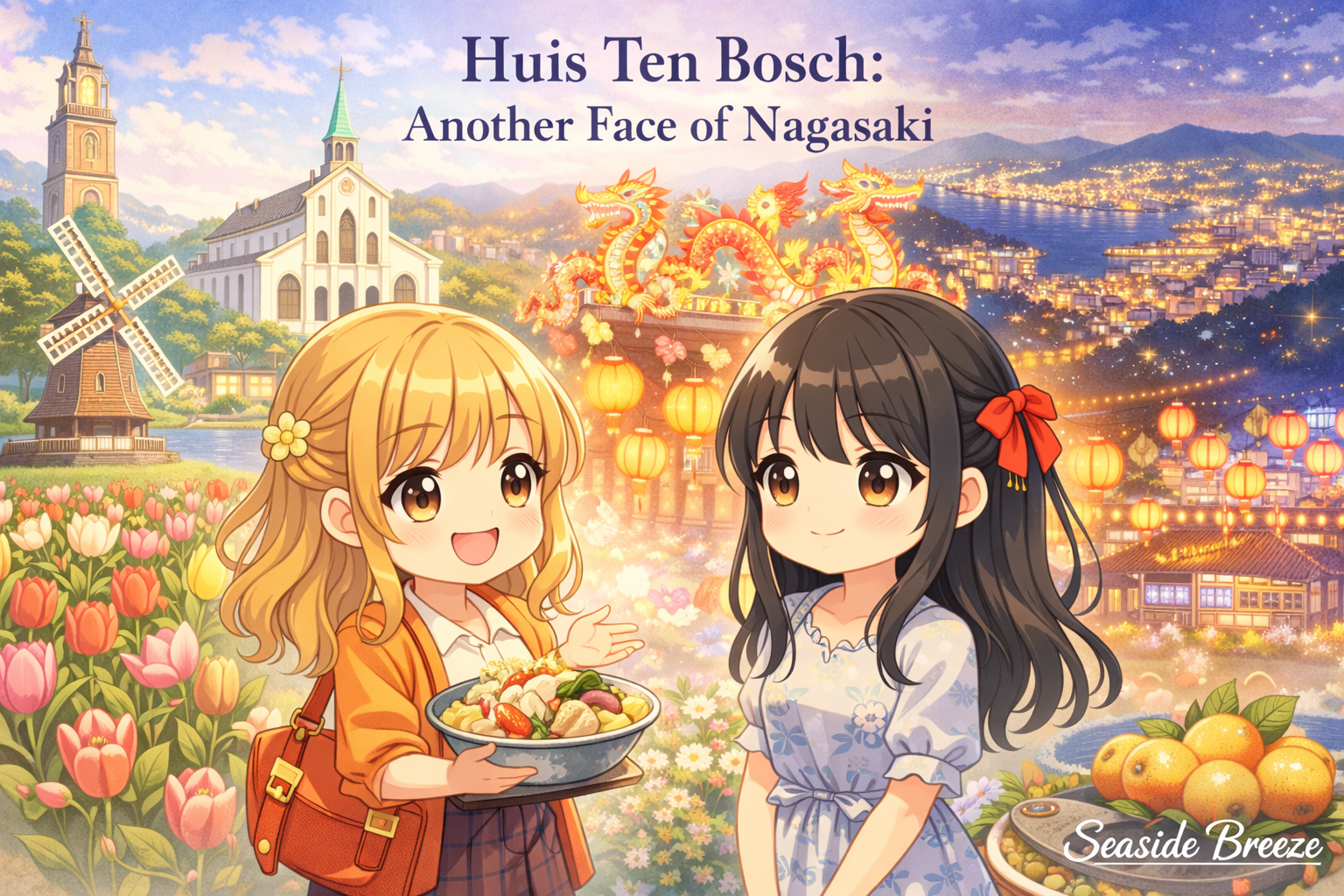
One of the best examples of that lighter side is Huis Ten Bosch in Sasebo. It is a large theme park built as a recreation of a Dutch town, created in 1992 to celebrate the long relationship between Japan and the Netherlands. Set along Omura Bay, it is filled with canals, European-style buildings, windmills, seasonal flowers, and night illuminations. For many visitors, it feels surprising at first. A Dutch-looking town in Japan might sound strange on paper, but in Nagasaki it somehow makes sense. This prefecture has spent centuries turning contact with other cultures into something local, and Huis Ten Bosch feels like a modern version of that habit. 
That is what makes it more interesting than a simple amusement park. Huis Ten Bosch is not important because it copies Europe perfectly. Its real charm is that it shows how comfortable Nagasaki is with cultural mixing. In some places, foreign style can feel decorative or artificial. In Nagasaki, it feels more natural. The prefecture has a long memory of meeting the outside world, so even a place as theatrical as Huis Ten Bosch seems connected to the wider character of the region. It is another example of how Nagasaki absorbs things from elsewhere and gives them a different life of its own. This is partly an inference, but it fits both the official description of Huis Ten Bosch as a celebration of Dutch-Japanese friendship and the broader tourism framing of Nagasaki as a place shaped by cultural contact. 
It also helps that the park is not only about architecture. It changes with the seasons. Tulips and spring flowers give it one mood, while the famous illuminations at night give it another. Official tourism guidance highlights both its flower festivals and its large-scale night light displays as major attractions. That means the experience is not only about looking at old-style buildings. It is about atmosphere. In daylight, the park can feel bright and cheerful. After sunset, it becomes a place of reflections, glowing streets, and carefully staged beauty. 
That sensitivity to light connects surprisingly well with another well-known side of Nagasaki: the Lantern Festival. The Nagasaki Lantern Festival began as a Chinese New Year celebration in Shinchi Chinatown and later grew into one of the city’s major winter traditions. During the festival, around 15,000 lanterns decorate the city center, turning ordinary streets into a sea of color. In a way, Huis Ten Bosch and the Lantern Festival belong to different worlds. One looks toward a Dutch-inspired fantasy town, while the other grows from Chinese community tradition in Nagasaki. But both reveal something similar. Nagasaki has long been good at making imported culture visible, enjoyable, and emotionally memorable. 
Food also helps explain that appeal. Nagasaki is often associated with champon and castella, and for good reason, but the prefecture’s tastes are wider than those two famous names. Loquat is one of Nagasaki’s signature fruits, and official prefectural sources note that more than 40 percent of all loquats shipped in Japan come from Nagasaki. That fact says something about the land as well as the food. The mild climate and varied terrain do not only produce beautiful scenery. They also shape the prefecture’s seasonal flavors. A fruit like loquat adds a softer image to Nagasaki, one that sits comfortably beside the port history and the foreign architecture. 
The sea matters just as much. Official Nagasaki tourism materials describe the prefecture as a place blessed with abundant seafood, and they specifically recommend horse mackerel as one of the must-try local specialties. That is easy to understand. Nagasaki is surrounded by water, and the relationship between sea routes and daily life has always been one of its defining features. In some prefectures, food culture is centered mainly on rice fields or mountain villages. In Nagasaki, the sea is always nearby, and that presence reaches the table in a very direct way. Fresh fish, local dishes, and casual meals all carry some part of that maritime identity. 
Seen this way, Huis Ten Bosch becomes more than a separate tourist spot. It is part of a wider Nagasaki mood. This is a prefecture where history can feel heavy, but everyday enjoyment still has an important place. You can spend one day thinking about prayer, memory, or the difficult weight of the past, and another day enjoying flowers, lights, sweets, and a slightly unreal Dutch street by the water. Those experiences do not cancel each other out. In Nagasaki, they coexist.
That may be one reason why the prefecture leaves such a deep impression. Nagasaki is not only solemn, and it is not only exotic. It is not only historical, and it is not only picturesque. It has a way of moving between those moods without losing itself. Huis Ten Bosch shows that especially well. It presents a bright, welcoming, almost playful face of Nagasaki, but that playfulness still grows from the same long story of openness, adaptation, and curiosity. 
So if one side of Nagasaki is remembered through churches, memorials, and old port history, another side can be seen in lights, flowers, and the pleasure of wandering through an unexpected landscape. Add the Lantern Festival, the sweetness of local loquats, and the freshness of seafood from the surrounding waters, and the picture becomes even richer. Nagasaki is not a place with only one identity. It is a prefecture with many tones, and Huis Ten Bosch helps reveal one of its most vivid and enjoyable ones. 
(今回のお話を要約するとこのような内容になります)
長崎県には歴史や祈りのイメージだけでなく、もっと明るく華やかな顔もあります
ハウステンボスは、オランダ風の街並みや花、イルミネーションが楽しめる場所で、長崎が昔から持っている「外の文化を自分の土地に取り込む力」を現代的に見せてくれる存在です
さらに、ランタンフェスティバルの灯り、びわのやさしい甘さ、海に近い県ならではの魚のおいしさまで含めて見ると、長崎はひとつの印象では語れない、とても表情の豊かな県だと思います

コメント