(日本語の要約は最後にあります)
When people think of Nagasaki, they often imagine a port city shaped by contact with the outside world. That image is true, but it is only part of the story. After looking at Nagasaki’s narrow sea gateways in the first part, and its blended culture in the second, the third step is to notice something quieter. Nagasaki is also a place where memory stays close to the surface. Faith, loss, survival, and reflection are not separate from the city’s identity. They are part of what gives Nagasaki its distinctive emotional weight. 
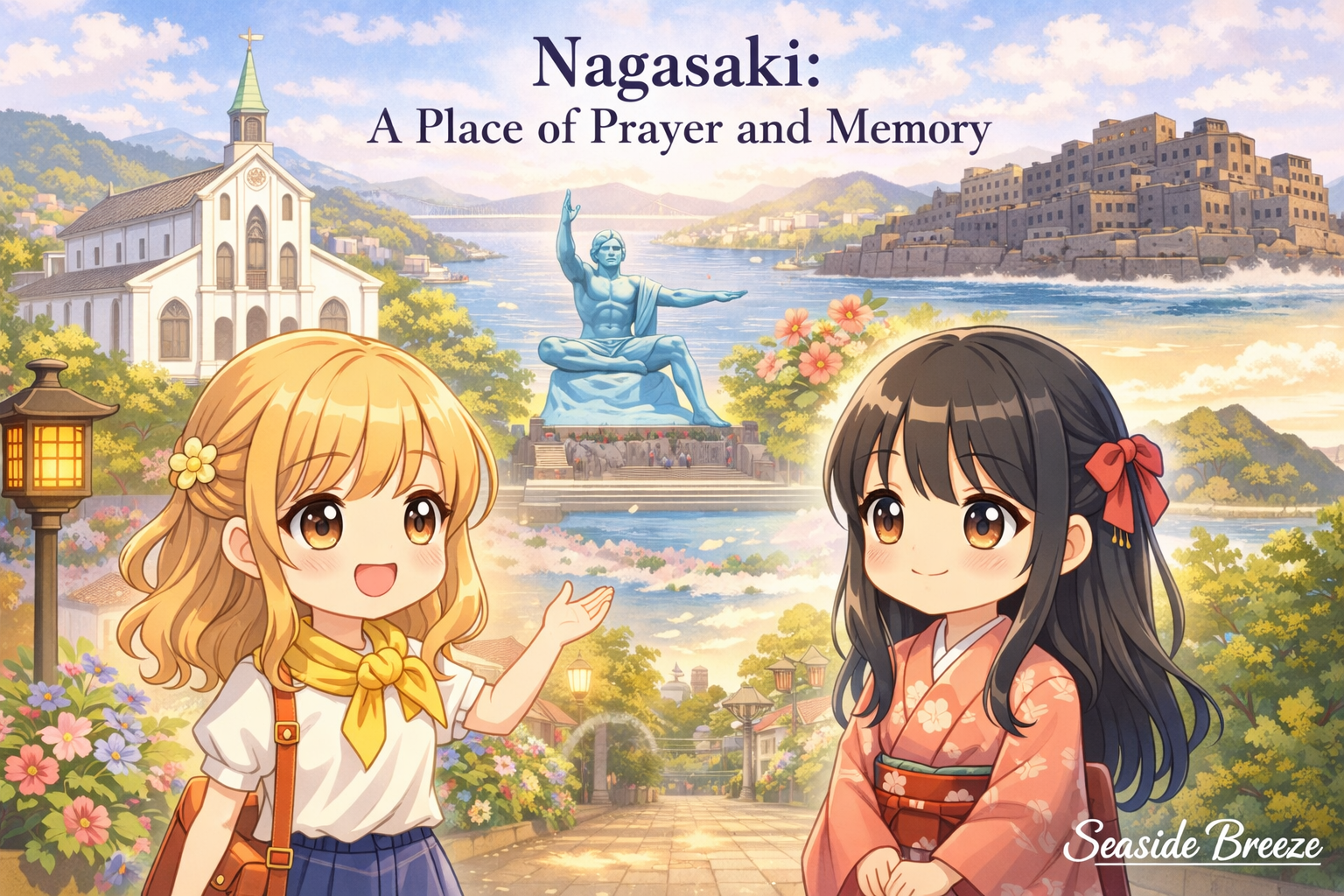
One of the clearest symbols of that deeper side is Oura Cathedral. It stands on a hill facing Nagasaki Port, and it is closely connected with one of the most important moments in the history of Christianity in Japan. After long years in which Christianity had been prohibited, Hidden Christians in the Nagasaki region made contact there with missionaries in the nineteenth century, in what became known as the “Discovery of the Hidden Christians.” That moment matters because it tells us something essential about Nagasaki. This was not only a place where foreign culture entered Japan. It was also a place where faith was protected quietly, carried through generations, and revealed only when the time finally changed. 
That history gives Nagasaki a different atmosphere from many other Japanese cities. In some places, history is remembered mainly through castles, battlefields, or political change. In Nagasaki, part of the past survives through prayer. Churches are important here not only as buildings, but as signs of endurance. Oura Cathedral is especially powerful in that sense. It is connected to foreign residents, to missionary work, and to the end of a hidden chapter in Japanese religious history, but it also feels personal. The story it carries is not only about institutions. It is about ordinary people who kept believing in secret for generations. 
Another place that defines Nagasaki is Peace Park. It was built to commemorate the atomic bombing of the city on August 9, 1945, and to express hope that such destruction should never happen again. Today the park, the nearby memorial spaces, and the Peace Statue give Nagasaki a role that goes beyond local history. They make the city one of the places in Japan where memory is tied directly to a public wish for peace. This part of Nagasaki’s identity is impossible to ignore. The city is not only remembered for exchange with foreign cultures, but also for the way it turns tragedy into an ongoing act of remembrance. 
What is striking is that these layers of memory do not feel separated from daily life. In Nagasaki, the sea is still beautiful, the slopes are still full of life, and the city still carries the charm of an old international port. But alongside that beauty there is also a strong awareness of what has been lost and what must not be forgotten. That balance gives Nagasaki a tone that feels different from simple nostalgia. It is not only a city that remembers the past. It is a city that keeps speaking to the present through that past. 
There is also another kind of memory in Nagasaki, one connected not to religion or war, but to modern industry. Hashima Island, often called Gunkanjima, points to that side of the prefecture. UNESCO includes Hashima within the Sites of Japan’s Meiji Industrial Revolution, a group of places tied to shipbuilding, coal mining, and the rapid industrialization that transformed Japan from the mid-nineteenth century into the early twentieth century. In the context of Nagasaki, Hashima feels like a reminder that progress also leaves ruins behind. It adds a darker industrial silhouette to the prefecture’s identity. 
That is part of what makes Nagasaki so compelling. Its story is not built from a single symbol. It is a place where international exchange, hidden faith, wartime memory, and industrial modernity all exist within the same landscape. Oura Cathedral speaks of quiet endurance. Peace Park speaks of mourning and hope. Hashima suggests the ambition and cost of modernization. Put together, they make Nagasaki feel broader and deeper than a simple “historic port city.” 
So if the first step to understanding Nagasaki is to look at the sea, and the second is to look at culture, the third is to look at memory. Nagasaki is a place where prayer was kept alive in secret, where peace is spoken of in public, and where the marks of history were never fully erased. That is why the prefecture leaves such a lasting impression. It is not only beautiful or unusual. It feels thoughtful. Nagasaki carries the sense that history is still present there, quietly shaping the meaning of the city even now. 
(今回のお話を要約するとこのような内容になります)
長崎県は、海外との交流や異国文化だけで語れる土地ではなく、祈りと記憶が今も深く残る県でもあります
大浦天主堂は潜伏キリシタンの歴史を象徴し、平和公園は原爆の記憶と平和への願いを今に伝えています
さらに軍艦島は近代化の光と影を思わせる存在です
長崎は、文化が混ざった港町であると同時に、過去を静かに抱え続ける場所だと言えます


コメント