(日本語の要約は最後にあります)
When people think of Nagasaki, they often imagine a port city with a long history of contact with the outside world. That image is correct, but what makes Nagasaki especially interesting is not simply that it was open to foreign countries. It is that different cultures met there, mixed there, and slowly became part of everyday life.
This is one of the reasons Nagasaki feels different from many other places in Japan. In some prefectures, local culture grew mainly from agriculture, castle towns, or inland trade. Nagasaki, by contrast, developed through the sea. Ships arrived, people came and went, and ideas crossed the water along with goods. Over time, those contacts shaped the food, architecture, language, and atmosphere of the region.
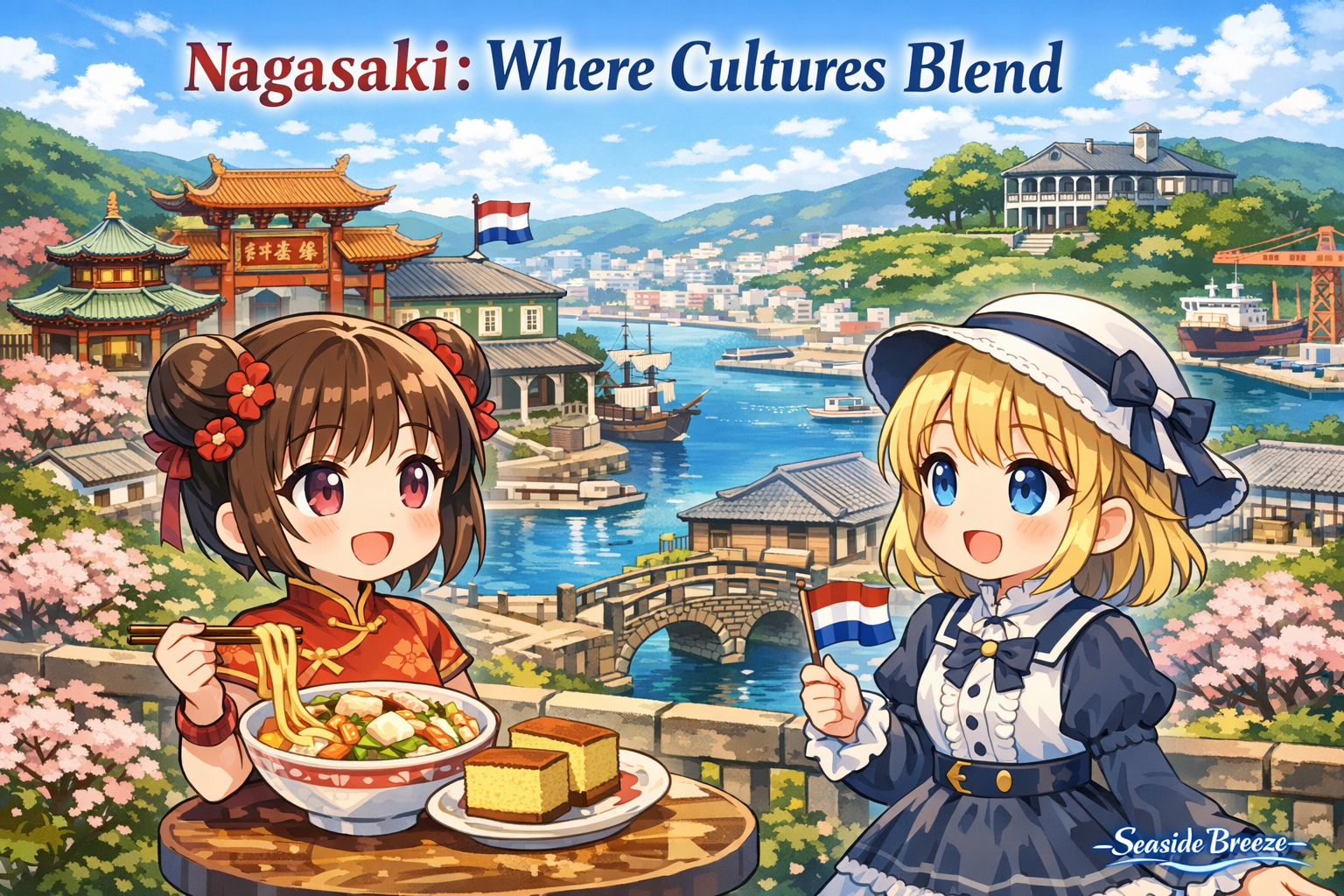
A useful word for this is “Wakaran.” It refers to a blend of Japanese, Chinese, and Dutch influences. Few places in Japan show this mixture as clearly as Nagasaki. The city did not simply borrow foreign elements and keep them separate. Instead, it turned them into something local. That is why Nagasaki’s culture feels both familiar and unusual at the same time.
Food is one of the easiest ways to see this. Nagasaki champon is now famous across Japan, but its roots are connected to Chinese food culture in the port city. It is a noodle dish filled with vegetables, seafood, and meat, and it reflects the everyday reality of a place where different communities lived close to one another. Castella is another well-known example. Although it is now seen as a classic Japanese sweet, its origin came from overseas. In Nagasaki, foreign influence did not remain foreign forever. It became part of local taste.
This same blending can be seen in the city itself. Areas connected with former foreign residents still give Nagasaki a special atmosphere. Western-style houses, stone paths, old churches, and views of the harbor create a mood that is hard to confuse with any other Japanese city. Glover Garden is one of the places where visitors can still feel this layer of history. It is not only a beautiful site. It also reminds us that Nagasaki once had a daily life shaped by international contact.
Even more symbolic is Dejima. During the Edo period, when Japan limited most foreign relations, Dejima became one of the few places where the country remained connected to Europe, especially through the Dutch. Because of that connection, Nagasaki became an important gateway not only for trade, but also for knowledge. Western medicine, science, and new ways of thinking entered Japan through this narrow opening. In that sense, Nagasaki was not only a port for goods. It was also a port for ideas.
That is what makes the culture of Nagasaki so rich. It was created not by a single tradition, but by repeated contact and careful adaptation. Chinese influence, Dutch learning, Japanese customs, and local life all came together in one place. The result was not confusion, but a distinct regional culture that still feels alive today.
Modern visitors may notice this in simple things at first: the food, the street views, the old buildings, and the slightly different atmosphere of the city. But behind those impressions is a deeper story. Nagasaki shows that cultural exchange is not always dramatic. Sometimes it happens slowly, through meals, neighborhoods, trade routes, and daily habits. Over time, those small changes become identity.
That is why Nagasaki is more than a historic port. It is one of the places in Japan where cultural blending became visible, lasting, and local. If the first step to understanding Nagasaki is to look at its narrow sea gateways, the second step is to see what came through them. What arrived was not only trade, but culture itself.
(今回のお話を要約するとこのような内容になります)
長崎の魅力は、ただ海外に開かれていたことではなく、日本、中国、オランダの文化が交わり、それが土地の暮らしに溶け込んだことにあります
ちゃんぽんやカステラのような食べ物、グラバー園や出島のような場所には、その混ざり合いの歴史が今も残っています
長崎は、物だけでなく知識や考え方まで行き交った港町であり、その積み重ねが独特の文化を形づくった県だと言えます


コメント